One CPU Kept Up With 408 Logical Qubits in IonQ's Tests
IonQ said on 22 September that its error-correction decoder ran in real time on a single off-the-shelf processor. The underlying preprint reports a wider range of overheads than the press release quotes.
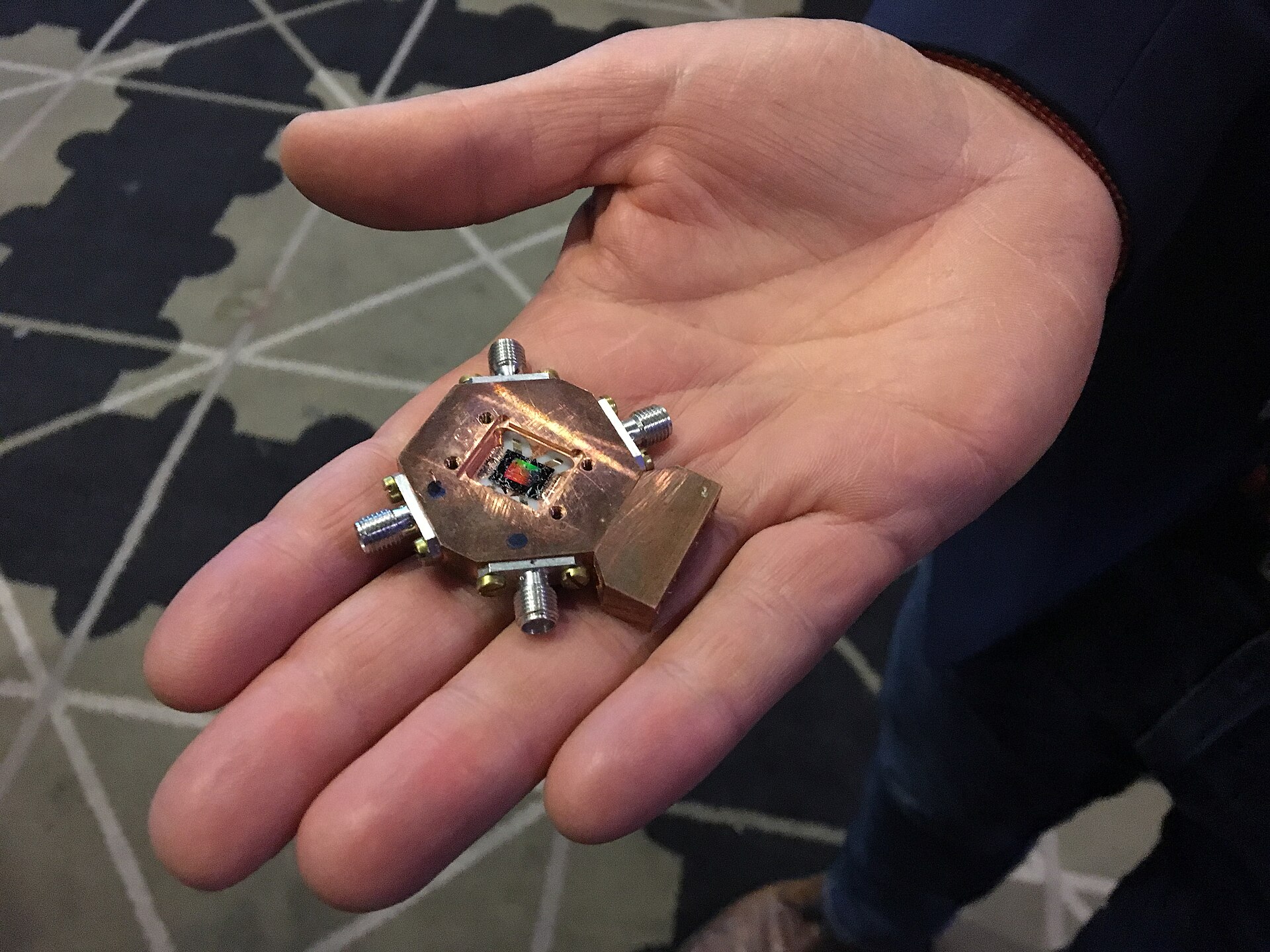
IonQ said on 22 September 2026 that its researchers had built and tested what it describes as the first end-to-end real-time quantum error correction decoder capable of running on a single standard off-the-shelf central processing unit. The claim rests on a preprint, arXiv:2608.25027, titled 'Real-time decoder for a MegaQuOp quantum computer using a single CPU', by Min Ye, Andrii Maksymov and Nicolas Delfosse. It was first posted on 25 August 2026 and revised on 3 September.
Decoding is the classical half of quantum error correction. Physical qubits pick up errors from their environment, and a classical computer must read the resulting syndrome data and work out what went wrong faster than new errors arrive. If it cannot keep up, the quantum processor waits. Teams have generally solved this with FPGA or GPU clusters.
The paper's pipeline covers on-the-fly detector error model generation, decoding of all logical qubits, logical operations and magic-state factories, and the authors report benchmarking it on quantum applications spanning up to 408 logical qubits and up to one million T gates.
Which overhead figure
IonQ's announcement states that under standard operational noise the decoder introduced as little as 0.02% stretch time, meaning near-zero added delay. The abstract of the paper the company links to gives different numbers. Assuming a trapped-ion architecture with a 1 to 5 millisecond cycle time, the authors write that the decoding delay stretches the computation by less than 0.3% at a two-qubit gate error rate of 10 to the minus 4, and by less than 12% at 5 times 10 to the minus 4, for all workloads studied. The press release quotes the best case; the paper states the bounds, and the worse of the two error rates costs roughly an eighth of the runtime.
Successfully validating real-time decoding across hundreds of logical qubits and over millions of logical operations is an important milestone. Moreover, the fact that our decoder runs on a single CPU provides a practical path to commercial-scale fault-tolerant quantum computing
A real processor, simulated qubits
The distinction that matters is which half of the system was physical. The decoder ran on actual classical hardware and its timing is a measured result. The 408 logical qubits, the 88 memory blocks and the magic-state factories were simulated, because no machine in existence can supply them. IonQ's own release describes the work as establishing a foundation for a roadmap that goes beyond 256 physical qubits toward platforms controlling thousands. Error-corrected logical qubits consume many physical qubits each, so 408 of them sits well past anything IonQ has built.
The result belongs to a pattern Parallax Nexus has followed in physics, where computational design work increasingly sets the pace of what experimentalists can attempt rather than merely analysing what they have already done.
The preprint has not been peer reviewed. Its second version corrected a description of the simulated Heisenberg Hamiltonian, which is defined on a degree-three random regular graph rather than the degree-seven graph stated in the first version, and added detail on logical frame tracking, inter-block logical measurements and the simulation of magic-state factories. IonQ shares rose about 7% in after-hours trading on Tuesday following the announcement, according to Investing.com.
The honest reading is that this is a real and useful negative result dressed as a positive one: it shows that classical decoding does not have to scale exponentially with the width or depth of a fault-tolerant computation, which removes a cost line that some roadmaps had assumed. It does not move any qubit count forward. The question the paper answers is whether the control electronics become the bottleneck, and the answer is that for trapped-ion cycle times of milliseconds they need not.
What is not known is how the same decoder behaves on superconducting architectures, where cycle times are microseconds rather than milliseconds and the classical budget is a thousand times tighter. The paper's margin comes substantially from the slowness of trapped ions, and IonQ does not claim otherwise.
What happens next?
- The preprint awaits peer review and independent replication of the timing results.
- IonQ has not said when the decoder will be paired with physical error-corrected hardware rather than simulated workloads.
- A comparable demonstration on superconducting hardware, with microsecond cycle times, would test whether the approach generalises.
Related topics
Sources & references
- 01Real-time decoder for a MegaQuOp quantum computer using a single CPU — arXivresearchSubmitted 25 August 2026, v2 revised 3 September 2026; source of the 0.3% and 12% overhead bounds
- 02IonQ Demonstrates Industry's First End-to-End Real-Time Quantum Error Decoder — IonQcompany22 September 2026 press release; source of the 0.02% figure and both quotes
- 03IonQ Demonstrates Real-Time QEC Decoding at MegaQuOp Scale on Single Commodity CPU — Quantum Computing Reportnews22 September 2026 trade coverage
- 04IonQ stock jumps 7% on quantum error correction breakthrough — Investing.comnews22 September 2026; after-hours share move
More from Science

Perseverance Finds Three Water Episodes in Jezero's Margin Rocks
NASA said on 21 September 2026 that Perseverance data from Jezero Crater's Margin Unit, published in Communications Earth & Environment, show igneous olivine rock that interacted with water on at least three occasions: carbon dioxide-rich groundwater, probably the crater lake, and a later heated event that left fluorite.

Maynooth’s DNA Computer Reaches Its Answer by Cooling Down
Maynooth University researchers published a Scaffolded DNA Computer in Nature on 16 September 2026. It ran ten programs, including addition of 25-bit numbers, by making the correct output the energetically favoured state. Small sums take seconds; the largest took up to 14 hours.
The AI-Designed Drug That Turned Back Six Clocks
A Nature Biotechnology paper published on 7 September 2026 ran six proteomic ageing clocks inside a randomised phase 2a trial of rentosertib for idiopathic pulmonary fibrosis and found reductions in predicted biological age, most consistently at week four in the 30 mg twice-daily arm. Phase III dosing began the same week.
Quantum Computing: A Reality Check
What has actually been demonstrated in quantum computing, what has not, and why post-quantum migration is the practical priority regardless of hardware timelines.