Sheltering From Heat Adds 46 Radon Deaths per 10,000
A paper in Communications Sustainability models what happens when people run air conditioning harder and move to cooler basements. The radon dose rises by half, and the modelled lung cancer toll rises with it.
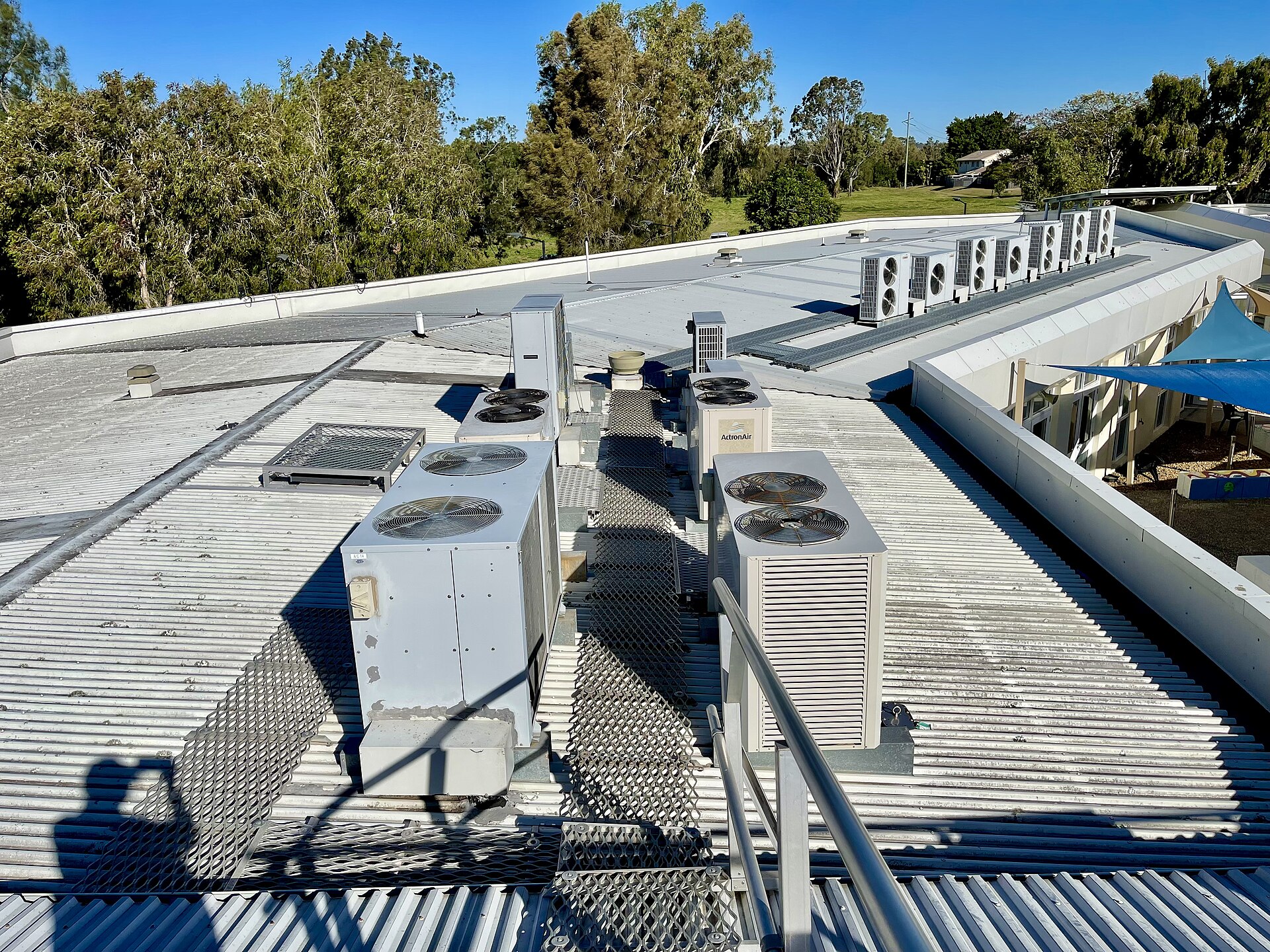
Running air conditioning through three summer months and spending four extra hours a day in a basement would add 46 lung cancer deaths per 10,000 people in the United States by age 85, according to a paper published in Communications Sustainability on 17 October 2026. In a pooled French, German and Italian population the same pattern added 42 deaths per 10,000. The mechanism is radon, the radioactive gas that seeps from uranium in the earth's crust into the lowest floors of buildings.
The point of the paper is that the behaviours in question are the ones public health authorities recommend during heatwaves. Staying indoors, cooling the house and seeking out the coolest room are standard advice. All three raise the time spent breathing air that holds radon progeny, the short-lived decay products that deliver alpha radiation to the lungs. Radon is a Group 1 human carcinogen in the International Agency for Research on Cancer's classification, and the paper's own literature review puts it behind 3 to 14 per cent of lung cancer deaths worldwide.
One reference house, four ways of living in it
Heechan Lee and David B. Richardson of the Department of Environmental and Occupational Health at the University of California, Irvine, with Niccolò Loret, Sara Antignani and Francesco Bochicchio of the Italian National Institute of Health in Rome, built the estimates on a single modelled house: 74 becquerels per cubic metre on the first floor and 185 on the basement level. Against that house they set four patterns of life. Current conditions assume 21 hours indoors and three outdoors, giving an annual dose of 0.376 working level months. Three months of heavier air conditioning, which the literature suggests raises indoor concentrations by 60 per cent, takes it to 0.431. Shifting four hours a day into the basement plus one more hour indoors takes it to 0.492. Doing both takes it to 0.564, half again as much as the baseline.
Cumulative excess lung cancer deaths by age 85. United States: Current conditions 91deaths per 10,000, More air conditioning 104deaths per 10,000, More time in basement 119deaths per 10,000, Both combined 137deaths per 10,000. France, Germany and Italy pooled: Current conditions 86deaths per 10,000, More air conditioning 98deaths per 10,000, More time in basement 112deaths per 10,000, Both combined 128deaths per 10,000.
Read as differences rather than totals, the air conditioning scenario alone adds 13 deaths per 10,000 in the United States and 12 in Europe. The basement scenario adds 28 and 26. The combination adds 46 and 42. The gap between the two populations comes from different baseline lung cancer mortality rates, not from different physics.
How much the model carries
The risk conversion comes from the exposure-age-concentration model in the US National Academies' BEIR VI report. That choice matters, and the authors say so. BEIR VI itself does not conclude that this model is preferable to its exposure-age-duration alternative, and the two can diverge meaningfully at residential radon levels. The confidence intervals are wide: the US baseline of 91 deaths per 10,000 spans 30 to 221, and the combined scenario's 137 spans 44 to 330, because the underlying risk coefficient carries a multiplicative standard error of 1.94.
The authors ran the same scenarios through two other models. The Pooling Uranium Miners Analysis model produced estimates 27 to 31 per cent higher. The Darby residential model, built from a pooled analysis of 13 European case-control studies, produced estimates 58 to 60 per cent lower. All three agreed on direction: every scenario raised risk relative to the baseline. The spread between them is the honest measure of how precisely this can be known.
What the paper declines to claim
These are not predictions. The paper states that the scenarios "should therefore not be interpreted as precise forecasts of population-wide behavioural shifts in any specific country", and that their purpose is to show the magnitude of change an individual adopting such habits would face. The behavioural assumptions are drawn largely from the United States, where residential air conditioning is common; the authors note that European penetration remains lower, though rising. Nor does the paper model the other pathways it identifies in its review, including radon release from thawing permafrost and the tighter building envelopes that energy-efficiency rules encourage.
The judgment worth making is that this is a paper about advice rather than about climate. Nothing in it requires the climate to warm by any particular amount; it requires only that people follow heat guidance in houses that already have radon in them. That makes the finding unusually actionable, because the countermeasure is cheap and known. Testing a house costs tens of pounds and sub-slab depressurisation systems are standard retrofit work. As Parallax Nexus reported on 8 October, modelling in Earth's Future already puts 2023-level tropical heat at every-year frequency from 2043 in most tropical regions, which is the sort of timeline on which spending more of the day indoors stops being an emergency measure and becomes the ordinary way to live.
What happens next?
- Watch whether national radon programmes in the US and Europe revise guidance to account for longer indoor hours during heat events.
- The authors call for the other pathways in their review, including permafrost thaw and building airtightness, to be modelled directly.
- Any firmer estimate depends on measured data on how heat actually changes time-activity patterns, which the paper substitutes with scenarios.
Related topics
Sources & references
- 01Climate change exacerbates residential radon exposure and lung cancer risk — Communications SustainabilityresearchLee, Loret, Antignani, Bochicchio and Richardson. Received 28 May 2026, accepted 22 September 2026, published 17 October 2026. Volume 1, article 160. Open access under CC BY 4.0.
- 02BEIR VI: Health Effects of Exposure to Radon — US National Academies of Sciences, Engineering, and MedicinereportSource of the exposure-age-concentration model and the risk coefficients used for the estimates.
- 03IARC Monographs Volume 100D: Radiation — International Agency for Research on CancerresearchClassification of radon and its decay products as a Group 1 human carcinogen.
More from Science
OpenAI Says Its Models Disproved the Exponential Time Hypothesis
OpenAI announced on 26 October 2026 that its internal models produced a disproof of the Exponential Time Hypothesis, a proof of the local smoothing conjecture in every dimension, and an existence proof for quantum chromodynamics. It is handing verification to unpaid external groups rather than to journals.
mRNA Melanoma Vaccine Cuts Recurrence Risk by 42%
Merck and Moderna reported a hazard ratio of 0.58 for recurrence-free survival in more than 1,100 patients with completely resected stage IIB to IV melanoma, the first phase 3 evidence that a vaccine built from each patient's own tumour mutations adds to a checkpoint inhibitor.

MMX Is on Its Way to Phobos With a 10-Gram Target
MMX separated from H3 flight No.10 about 71 minutes after liftoff from Tanegashima. If the five-year plan holds, it will collect at least 10 grams of regolith from the Martian moon Phobos and drop a capsule in Australia in 2031.

Antarctic Ice Cliffs Calve Faster Than Models, Then Stop
A study in Science on 15 October 2026 maps more than 15,000 Antarctic ice cliffs and finds the tall ones collapse faster than models assumed, then restabilise instead of eroding the ice sheet behind them. The authors argue Thwaites Glacier would not retreat immediately even if its shelf failed.